
Wildfire Detection Devices
1) The difference between existing and Eagle Technology's detection systems
Conventional wildfire detection technologies predominantly depend on thermal imaging cameras or closed-circuit television (CCTV) systems integrated with thermal sensors to identify high-temperature reactions associated with smoke and open flames. However, these systems are susceptible to false-positive detections—such as those triggered by chimney emissions or fog—and their performance can be further degraded under conditions of reduced atmospheric visibility, including cloud cover or dense haze.

Also, existing forest fire detection operates with CCTV cameras, so they are detected AFTER forest fires are spread uncontrollably to the surrounded areas rather than preventing fires.
The Eagle Technology’s early wildfire detection monitors forest fire BEFORE it occurs by collecting and analyzing the environmental condition such as, temperature and carbon dioxide equivalent (CO2e) in the area (100 yard radius) with the IoT sensors, and reports data to control centers in real time.
We install IoT sensors with Lora communication or LTE Communication to complement errors and shaded areas of image detection technology caused by unexpected weather condition.


2) The Eagle Technology’s Wildfire Sensor: “Redbin FL-100” (IoT sensor)
No battery: Solar Cell + Hybrid capacitor (<200 µA)
Power source: DC 5V
Network: Lora or LTE-m based sensors that can be set up anywhere
within LTE-m communication area using a global USIM
The AI wildfire surveillance system is based on Lora (LPWA) or LTE-m or Satellite or Starlink Communication for EARLY DETECTION BEFORE A FIRE BREAK OUT by monitoring the surrounding environment, such as CO2e, TVOC (Total Volatile Organic Compound), Temperatures, Humidity etc.
Installation: either Lora or LTE-m communication depending upon distance
Lora Network
LTE-m Communication


We recommend LTE-M communication in the forest area, as the LoRa system provides coverage of 1 km radios only and additionally requires a gateway, which necessitates a power installation.
2-a) Lora based IoT sensor: Lora Network (0.6 mile coverage using a Gateway)
“Redbin FL-100” is a IoT sensor with LPWL based wireless communication + Gateway (0.6 mile coverage);
IoT (Internet of Things) refers to interconnected devices to collect/exchange data through the internet.
Lora is a private wireless network with low power (US 902-928 MHz, ISM band or ethernet or WiFi)
to operate battery-powered devices in remote for IoT sensor services in 0.6 mile.


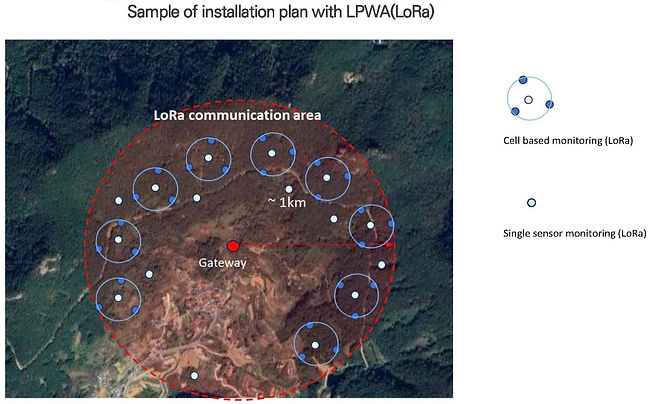

2-b) Network: LTE-m communication: No limit on distance, Phone charge cost
Mobile based cost with a global SIM
SOS function by installing a power station
(*Operates –30°C ~ +85°C: -22F-185F)
1. LTE-m communication runs the same way as a mobile phone, using a global USIM inserted into the device.
The USIM manufacturer has a contract with the three US telecommunications companies (Verizon, AT&T, T-Mobile). Depending on the region, the device automatically connects to whichever carrier provides the most stable service. The cost is settled between the USIM manufacturer and the telecommunications company.
2. USIM manufacturer: Telenor of Norway.
3. USIM can be purchased after signing the contract worldwide.
4. USIM rate and cost:
The cost must be negotiated with the manufacturer prior to executing the purchase agreement, and the usage period shall correspond to the duration of the user’s utilization.
The charges are applied based on data usage, with different rates applied in tiers starting from 10MB.
For example, in the case of another device previously in use, a charge of $0.59 was incurred for 10MB of data.
It is estimated that the monthly data usage of the wildfire detector is also similar to the usage cost of it.
Additionally, our fire devices have a SOS function; when you get lost in the mountain, press the SOS button attached to the sensor so that rescue teams notify your location.

